NHTSA Service Bulletin 10148179: 1999-2015 BMW 1 Series M
Official manufacturer communication context for 1999-2015 BMW 1 Series M, with affected products, buyer checks and links into Carchieve recall, problem and VIN research.
Reviewed June 2026 from NHTSA manufacturer communication and service bulletin records. Carchieve is independent and not affiliated with any vehicle manufacturer or government agency.
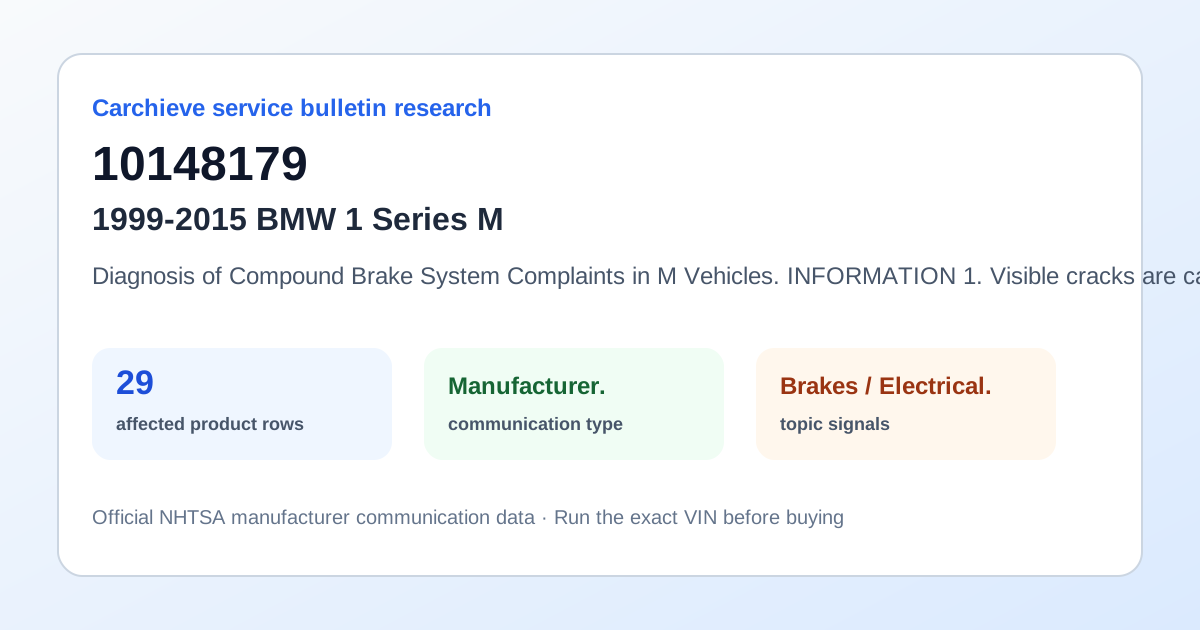
Diagnosis of Compound Brake System Complaints in M Vehicles. INFORMATION 1. Visible cracks are caused by high thermal stresses during rapid heating and cooling of the brake discs. Braking from high speed with cold brake components (less than 212 degrees F) increases the likelihood of cracks to form. These surface hairline cracks are usually spread over the entire brake disc friction area, and have no negative influence on the durability or braking performance. The rotors should not be replaced only for their appearance reasons. When performing routine service on the brake system (pad replacement due to wear), the brake discs should be replaced if surface cracks are found to be greater than 13 mm, or if the brake disc thickness is below the minimum thickness. Always replace brake discs in pairs (per axle). Install new brake pads when replacing discs. By doing this, the service life of the friction pad surface is increased, and an even material loss is ensured. 2. Vibrations and/or steering wheel torsional vibrations during braking are caused by applying the brakes on discs with minimal to heavy corrosion. These vibrations are most noticeable when braking from high speeds with cold brake components (less than 212 degrees F), and will diminish with normal everyday operation. Parts replacement is not required. 3. After high brake loads, running noises can be heard when applying the brakes, and may also be heard to a limited extent after the brakes are released. (See the note in the Owner's Manual). These noises are reduced during normal everyday operation, due to further erosion of the brake pad friction lining. Visible surface cracks or craterlike recesses on the brake pad surface are caused by a minor difference in the material of the pad lining, which will decrease with further operation and should not be replaced due to their appearance.
What this bulletin may mean before buying
Treat this as service research, not a verdict on one car. Before you buy, compare this communication with official recall campaigns, model-level owner complaint patterns, and the exact vehicle’s VIN-decoded specifications. A bulletin can help you ask a seller or dealer sharper questions about software updates, known repairs, warranty extensions and service history.
Affected products listed in this communication
Buyer checklist
- Run the 17-character VIN and confirm the year, make, model, engine and equipment match the listing.
- Check recall campaign pages for safety actions that may require dealer repair.
- Compare this bulletin with common problem pages for the same model and component area.
- Ask the seller or dealer whether the bulletin procedure, update or inspection has already been completed.
- Use the used-car buying checklist and get an independent inspection.
Frequently asked questions
What is NHTSA service bulletin 10148179?
Diagnosis of Compound Brake System Complaints in M Vehicles. INFORMATION 1. Visible cracks are caused by high thermal stresses during rapid heating and cooling of the brake discs. Braking from high speed with cold brake components (less than 212 degrees F) increases the likelihood of cracks to form. These surface hairline cracks are usually spread over the entire brake disc friction area, and have no negative.
Is a service bulletin the same as a recall?
No. A recall is a safety campaign with a required remedy for affected VINs. A service bulletin or manufacturer communication usually describes diagnostic, repair, software, warranty or service information.
How should a used-car buyer use this bulletin?
Use it as a research signal. Compare it with recalls, owner complaints, service records, a VIN report and an independent inspection before buying.
Check the exact VIN before you buy
Model-level pages show public safety patterns. A full VIN report helps confirm the exact vehicle, decoded specs, recall applicability and buyer checks.
Get Full Report