NHTSA Service Bulletin 11021142: 2003-2025 Mercedes Benz Amg A35
Official manufacturer communication context for 2003-2025 Mercedes Benz Amg A35, with affected products, buyer checks and links into Carchieve recall, problem and VIN research.
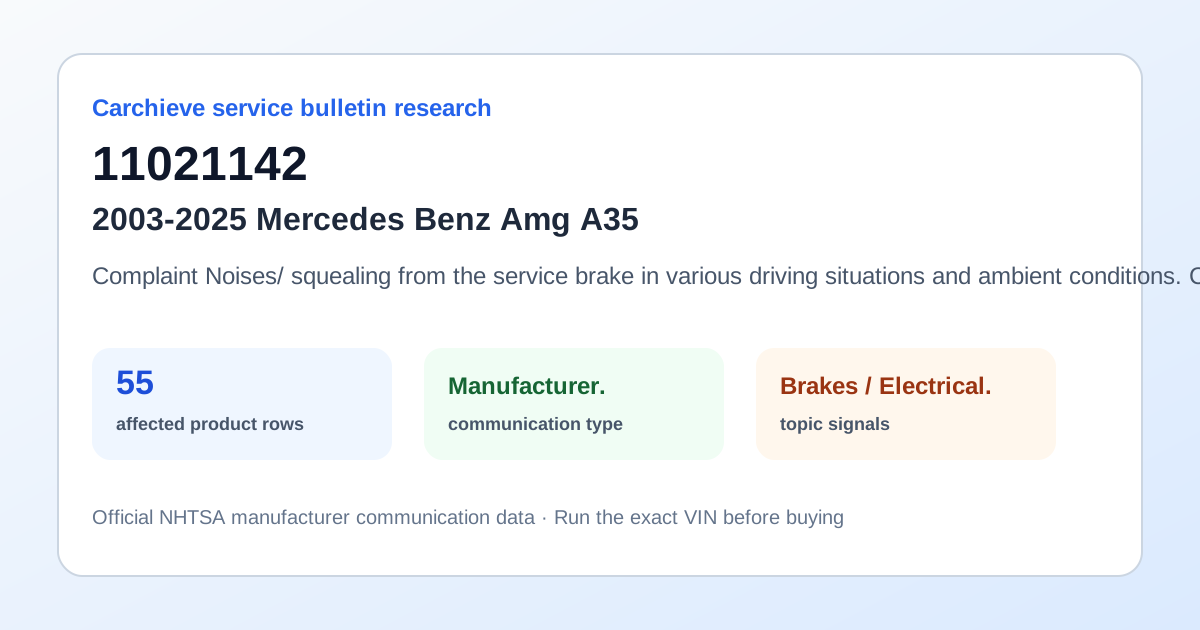
Reviewed June 2026 from NHTSA manufacturer communication and service bulletin records. Carchieve is independent and not affiliated with any vehicle manufacturer or government agency.
Complaint Noises/ squealing from the service brake in various driving situations and ambient conditions. Cause Frictional vibrations Remedy The intent of this document is to reduce or eliminate noise from high performance AMG brakes. AMG brakes are designed for performance under high load and in certain scenarios, can emit noise. Some of the scenarios are: Driving style Brake pressure and application style (stop-and-go traffic with consistent low brake pressure riding brakes where the brakes cannot cool sufficiently between applications). Ambient temperatures 1. Beginning Diagnostics: a) Check whether the complaint can be reproduced and at which axle or side the noises occur (ideally together with the customer while driving). b) Check the affected system for component wear, mechanical damage or localized overheating damage. Replace damaged components as necessary. c) Assess condition of brake rotors and pads per WIS and visually (i.e. long periods of stagnation, etc...). d) Clean brake components free of brake dust and debris. d) Secure vehicle on a lift. 1. Start the engine and depress the brake pedal 3-4 times. 2. Check each wheel to see if they turn freely by hand. 3. If a wheel is not turning freely by hand, this needs to be addressed prior to re-assessing the noise concern. e) Check whether, apart from this document, an additional document exists for the specific model in question, and if so, work through it and then continue. 2. Specific Axle Work: NOTE: If the brake pad has a metal backing plate, there is no need to affix the adhesive film. Continue with applying chamfer and Molykote as instructed below. IMPORTANT: Be absolutely certain to not allow paste between friction surfaces of the pad and disc! a) If the noises are coming from the front axle. 1. Remove brake linings of front axle. 2. Clean all contact points on brake lining backing plate, including the brake lining guide pins and brake caliper/carrier. 3. Clean bonding surface (where pistons contact back of brake pad). Apply adhesive film to the backplate of the piston-side brake lining where the piston contacts the pad backing plate. See picture "Adhesive and Paste Application Area". 4. Be sure to remove both brown paper backing sides of the adhesive film, it is double sided adhesive film. 5. If adhesive is already installed on backing plate where pistons contact the back of the pad, you may gently scrape off and re-apply a new adhesive or Molykote. Must not apply the Molykote on top of the adhesive. 6. Chamfer edges (gently round off sharp leading edges) on brake pads. Some pads have vertical grooves, these can be gently chamfered with a triangular file as well. See picture "Chamfering Technique". 7. Apply Molykote to the sides of the backing plate. See picture "Adhesive and Paste Application Area". 8. After installing the brake linings, actuate the brake for 30 seconds. b) If the noises are coming from the rear axle. 1. Remove brake pads of rear axle. 2. Clean all contact points on brake lining backing plate and brake caliper/carrier. 3. Clean bonding surface (where pistons contact back of brake pad). Apply adhesive film to the backplate of the piston-side brake lining. 4. Chamfer edges (round off sharp leading edges) on brake pads. See picture "Chamfering Technique". 5. Grease contact points (red areas on attachment "Rear Pad Grease Area") between brake lining and guide of brake caliper with Molykote. 3. Brake Bedding Process: a) Before trip, the mileage incurred must be clarified with the customer (approx. 30 miles). b) Select a suitable route so speeds of approximately 65 MPH can be achieved. c) If the vehicle is an AMG P3 Hybrid, switch off recouperation prior to bedding in brakes. d) Brake the vehicle 15 times with a brake pressure of approx. 30 bar (have the passenger read it out using XENTRY) from 62 MPH to 30 MPH (no emergency stops and no braking in the ESP control range). Maintain a cooling distance of approx. 1 mile between brake application
What this bulletin may mean before buying
Treat this as service research, not a verdict on one car. Before you buy, compare this communication with official recall campaigns, model-level owner complaint patterns, and the exact vehicle’s VIN-decoded specifications. A bulletin can help you ask a seller or dealer sharper questions about software updates, known repairs, warranty extensions and service history.
Affected products listed in this communication
Buyer checklist
- Run the 17-character VIN and confirm the year, make, model, engine and equipment match the listing.
- Check recall campaign pages for safety actions that may require dealer repair.
- Compare this bulletin with common problem pages for the same model and component area.
- Ask the seller or dealer whether the bulletin procedure, update or inspection has already been completed.
- Use the used-car buying checklist and get an independent inspection.
Frequently asked questions
What is NHTSA service bulletin 11021142?
Complaint Noises/ squealing from the service brake in various driving situations and ambient conditions. Cause Frictional vibrations Remedy The intent of this document is to reduce or eliminate noise from high performance AMG brakes. AMG brakes are designed for performance under high load and in certain scenarios, can emit noise. Some of the scenarios are: Driving style Brake pressure and application style.
Is a service bulletin the same as a recall?
No. A recall is a safety campaign with a required remedy for affected VINs. A service bulletin or manufacturer communication usually describes diagnostic, repair, software, warranty or service information.
How should a used-car buyer use this bulletin?
Use it as a research signal. Compare it with recalls, owner complaints, service records, a VIN report and an independent inspection before buying.
Check the exact VIN before you buy
Model-level pages show public safety patterns. A full VIN report helps confirm the exact vehicle, decoded specs, recall applicability and buyer checks.
Get Full Report