NHTSA Service Bulletin 11017041: 2021-2024 Mercedes-benz Amg S 63 E
Official manufacturer communication context for 2021-2024 Mercedes-benz Amg S 63 E, with affected products, buyer checks and links into Carchieve recall, problem and VIN research.
Reviewed June 2026 from NHTSA manufacturer communication and service bulletin records. Carchieve is independent and not affiliated with any vehicle manufacturer or government agency.
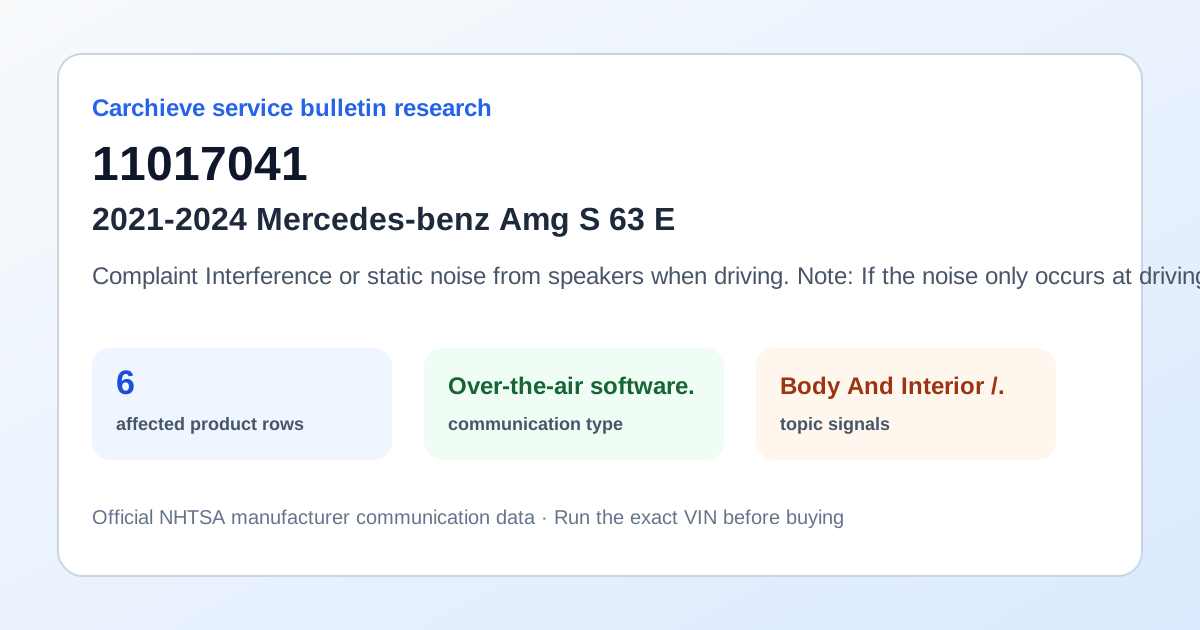
Complaint Interference or static noise from speakers when driving. Note: If the noise only occurs at driving speeds between 12mph (20 km/h) to 111mph (180 km/h), it is possible that the noise is being caused by the "active driving noise compensation" (RNC). If the static noise also occurs at speeds of less than 2mph (20 km/h) to 111mph (180 km/h), this static noise is NOT caused by the "active driving noise compensation" function. If the noise, after opening a window by more than 20 mm, or by opening the tilting roof opening a door opening the trunk lid is no longer perceptible, the noise is likely the result of unwanted compensation from the "active driving noise compensation" system. Cause Definition and introduction: Active driving noise compensation: A total of 6 RNS sensors are installed in the vehicle for the "Active driving noise compensation" function (SA code 96B). 1 sensor is located at each of the 4 wheel carriers, and the top left integral carrier and top right integral carrier also each have 1 sensor. If the microphones are not correctly engaged, this means that the microphone grille visible in the vehicle interior is not completely clipped on to the microphone attached behind the headliner. This can usually be noticed due to reduced sound quality when making telephone calls. In extreme cases, this may have an affect on the RNC system. The microphones could be connected to the wrong channels at control unit ASX 156/1, i.e. with swapped connections. The correct assignment of the microphones can be checked with XENTRY. (See remedy) Due to tolerances, it may be the case under certain circumstances that the angle bracket of the sensors at the integral carrier does not have sufficient contact with the integral carrier ("longitudinal member") of the body. It is also possible that the stipulated tightening torque of the screw connection has not been adhered to, which results in the transferred impulses being falsified. As a result, unintended vibrations may be transferred via the holder to the sensor. During assembly, the contact areas must be clean and free of dust and foreign objects. Control unit N156/1 then interprets these falsified signals as driving noise and attempts to compensate for this, which results in static noise coming through the speakers. These 6 sensors record the driving noises in 2 spatial directions each and transmit these noises as electrical impulses (digital bus) to the ASX control unit N156/1. In addition, 4 ANC microphones are installed in the vehicle interior, which are non-visibly attached in a electrically completely separated manner from the 4 voice/telephony microphones behind the shared microphone grille in the headliner. These 4 ANC microphones check the function of the RNC system. If the RNC system in the vehicle interior is outputting unwanted signals via the speakers, this may indicate that these microphones are operating on a limited basis. Remedy Remedy: If it has been verified that the noises are being caused by RNC, the following steps should be performed: Check that the components involved are functioning properly: 1. Check that the speakers are functioning correctly: Front bass left (H22/23), Front bass right (H22/24), subwoofer (trunk). If unusual or distorted sounds can be heard from these, the speakers should be checked for foreign objects in the vicinity of the voice coils or replaced if any noticeable problems appear to be permanent. 2. Check the event memory of the two control units N156 (ASX7) and N40 (SND7). 3. Erase the event memories and reset control unit N156/1 4. Check whether newer software versions are available for control units N156/1 (ASX7) and N40 (SND7) and perform an update if necessary. 5. Check whether the 4 ANC microphones are correctly connected. This check is essential and should be performed in any event when problems with the RNC system occur. To do so, display the microphone level of the 4 microphones in XENTRY (see the picture in
What this bulletin may mean before buying
Treat this as service research, not a verdict on one car. Before you buy, compare this communication with official recall campaigns, model-level owner complaint patterns, and the exact vehicle’s VIN-decoded specifications. A bulletin can help you ask a seller or dealer sharper questions about software updates, known repairs, warranty extensions and service history.
Affected products listed in this communication
Buyer checklist
- Run the 17-character VIN and confirm the year, make, model, engine and equipment match the listing.
- Check recall campaign pages for safety actions that may require dealer repair.
- Compare this bulletin with common problem pages for the same model and component area.
- Ask the seller or dealer whether the bulletin procedure, update or inspection has already been completed.
- Use the used-car buying checklist and get an independent inspection.
Frequently asked questions
What is NHTSA service bulletin 11017041?
Complaint Interference or static noise from speakers when driving. Note: If the noise only occurs at driving speeds between 12mph (20 km/h) to 111mph (180 km/h), it is possible that the noise is being caused by the "active driving noise compensation" (RNC). If the static noise also occurs at speeds of less than 2mph (20 km/h) to 111mph (180 km/h), this static noise is NOT caused by the "active driving noise.
Is a service bulletin the same as a recall?
No. A recall is a safety campaign with a required remedy for affected VINs. A service bulletin or manufacturer communication usually describes diagnostic, repair, software, warranty or service information.
How should a used-car buyer use this bulletin?
Use it as a research signal. Compare it with recalls, owner complaints, service records, a VIN report and an independent inspection before buying.
Check the exact VIN before you buy
Model-level pages show public safety patterns. A full VIN report helps confirm the exact vehicle, decoded specs, recall applicability and buyer checks.
Get Full Report