NHTSA Service Bulletin 11019973: 2019-2024 Freightliner Sprinter (Vs30)
Official manufacturer communication context for 2019-2024 Freightliner Sprinter (Vs30), with affected products, buyer checks and links into Carchieve recall, problem and VIN research.
Reviewed June 2026 from NHTSA manufacturer communication and service bulletin records. Carchieve is independent and not affiliated with any vehicle manufacturer or government agency.
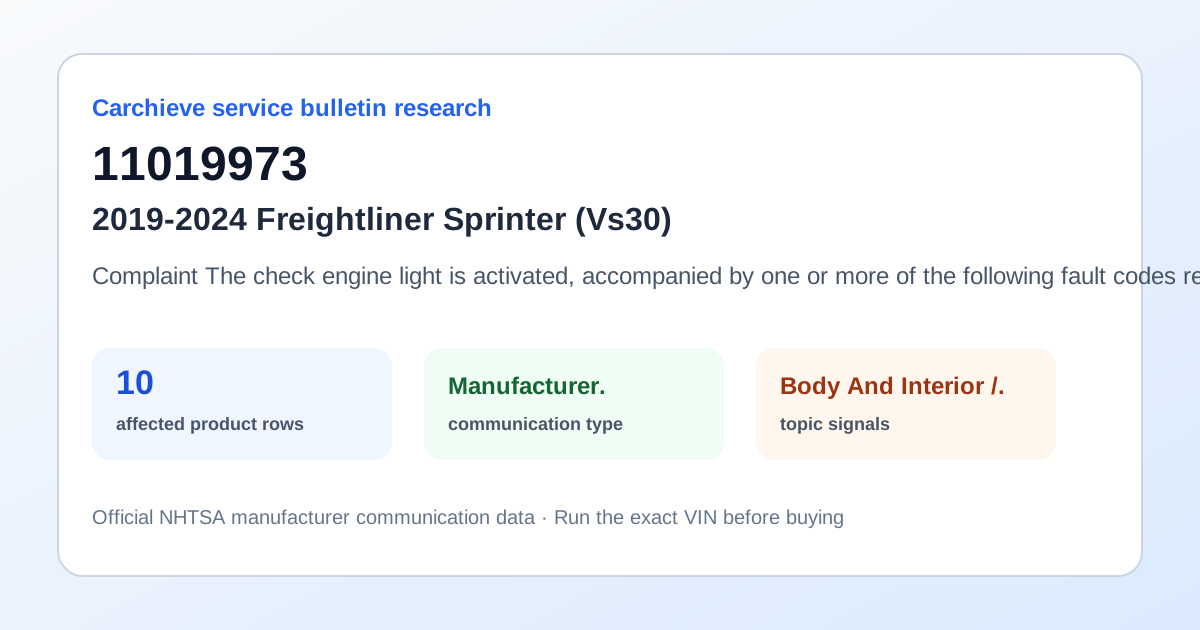
Complaint The check engine light is activated, accompanied by one or more of the following fault codes related to the Adblue System: P20F409: The Adblue consumption is too low. There is a component fault. P202E84: The Adblue metering valve 1 (Motor side) has a malfunction. There is a signal below the permissible limit value. Cause The potential causes for these fault codes are: A. A leak in the Adblue System B. An internal fault with the Adblue Injection Valve #1 (Motor side) C. An air pocket forming in the Adblue Injection Valve #1 (Motor side) Adblue Injector Line Remedy Vehicles Produced Before August 1, 2024 (Code XY4 = MY24) A. Leak in the AdBlue System 1. Complete the Guided Tests for DTC P20F409 or P202E84: Inspect the AdBlue tank, pump, line, and both injectors for leaks. Ensure the AdBlue line is properly routed, securely fastened, and not in contact with the exhaust system. Remove both AdBlue injection valves, perform 23 pressure build-ups, and check for AdBlue leaks. If a leak is detected, repair it and retest. B. Internal Fault with AdBlue Injection Valve #1 (Motor Side) 1. Process All Other Related DTCs First: Address any other fault codes relating to AdBlue injection valves before proceeding. If AdBlue Injection Valve #1 (engine side) fails the guided tests, replace it and retest. C. Air Pocket Forming in the AdBlue Line (Motor Side) 1. If Guided Tests Pass and No Leaks are Found: --Do not replace any components.-- The MY23-24 (Code XY4 = MY24, OM654) AdBlue line (A907 470 01 01) has a known design issue that can cause air pockets and DTC P20F409. This may also result in DTC P202E84, depending on the air pocket size. The guided tests for P20F409 now include resetting the learned values for the AdBlue delivery pump (A103m1). After this, the vehicle can be released to the customer. NOTE: Replacing the AdBlue tank or line will NOT resolve this air pocket issue. TIPS cases are no longer required for MY2324 vehicles. Steps to Perform (MY2324, Code XY4): 1. Complete the guided tests for DTC P20F409 and/or P202E84. 2. Perform an initial start-up of: The SCR control unit AdBlue tank components Both AdBlue injectors 3. Conduct a 20-mile test drive. If no faults occur, the vehicle can be released. 4. Inform the customer that frequent starting/stopping increases the likelihood of this fault due to repeated cycling of AdBlue in/out of the line each ignition cycle. Vehicles Produced After August 1, 2024 (Code XY5 = MY25) A. Leak in the AdBlue System 1. Complete the Guided Tests for DTC P20F409 or P202E84: Inspect the AdBlue tank, pump, line, and both injectors for leaks. Ensure the AdBlue line is properly routed, securely fastened, and not in contact with the exhaust system. Remove both AdBlue injection valves, perform 23 pressure build-ups, and check for AdBlue leaks. If a leak is detected, repair it and retest. B. Internal Fault with AdBlue Injection Valve #1 (Motor Side) 1. Process All Other Related DTCs First: Address any other fault codes relating to AdBlue injection valves before proceeding. If AdBlue Injection Valve #1 (engine side) fails the guided tests, replace it and retest. C. Incorrect AdBlue Injection Line Installed 1. Verify the Updated Line is Installed: Confirm that part number A907 470 33 02 is present. If the AdBlue line is incorrect (e.g., A907 470 01 01), replace it with the updated line. TIPS Case Instructions for All MY25 and Newer Vehicles If you encounter any of the issues above on any MY25 or newer vehicle, including finding an incorrect AdBlue line in- stalled: Open a TIPS case addressed to the Powertrain inbox. Reference this LI document. Include the following information: Description of the issue encountered (e.g., fault code, check engine light, or incorrect AdBlue injection line) Current Quick Test, SCR N118/5 Control Unit Log, and Guided Test results. Photo of AdBlue line part number label. Photos documenting any issues, leaks, or melting observed
What this bulletin may mean before buying
Treat this as service research, not a verdict on one car. Before you buy, compare this communication with official recall campaigns, model-level owner complaint patterns, and the exact vehicle’s VIN-decoded specifications. A bulletin can help you ask a seller or dealer sharper questions about software updates, known repairs, warranty extensions and service history.
Affected products listed in this communication
Buyer checklist
- Run the 17-character VIN and confirm the year, make, model, engine and equipment match the listing.
- Check recall campaign pages for safety actions that may require dealer repair.
- Compare this bulletin with common problem pages for the same model and component area.
- Ask the seller or dealer whether the bulletin procedure, update or inspection has already been completed.
- Use the used-car buying checklist and get an independent inspection.
Frequently asked questions
What is NHTSA service bulletin 11019973?
Complaint The check engine light is activated, accompanied by one or more of the following fault codes related to the Adblue System: P20F409: The Adblue consumption is too low. There is a component fault. P202E84: The Adblue metering valve 1 (Motor side) has a malfunction. There is a signal below the permissible limit value. Cause The potential causes for these fault codes are: A. A leak in the Adblue System B. An.
Is a service bulletin the same as a recall?
No. A recall is a safety campaign with a required remedy for affected VINs. A service bulletin or manufacturer communication usually describes diagnostic, repair, software, warranty or service information.
How should a used-car buyer use this bulletin?
Use it as a research signal. Compare it with recalls, owner complaints, service records, a VIN report and an independent inspection before buying.
Check the exact VIN before you buy
Model-level pages show public safety patterns. A full VIN report helps confirm the exact vehicle, decoded specs, recall applicability and buyer checks.
Get Full Report